
Pet Memorial Ideas: Meaningful Ways to Remember a Pet
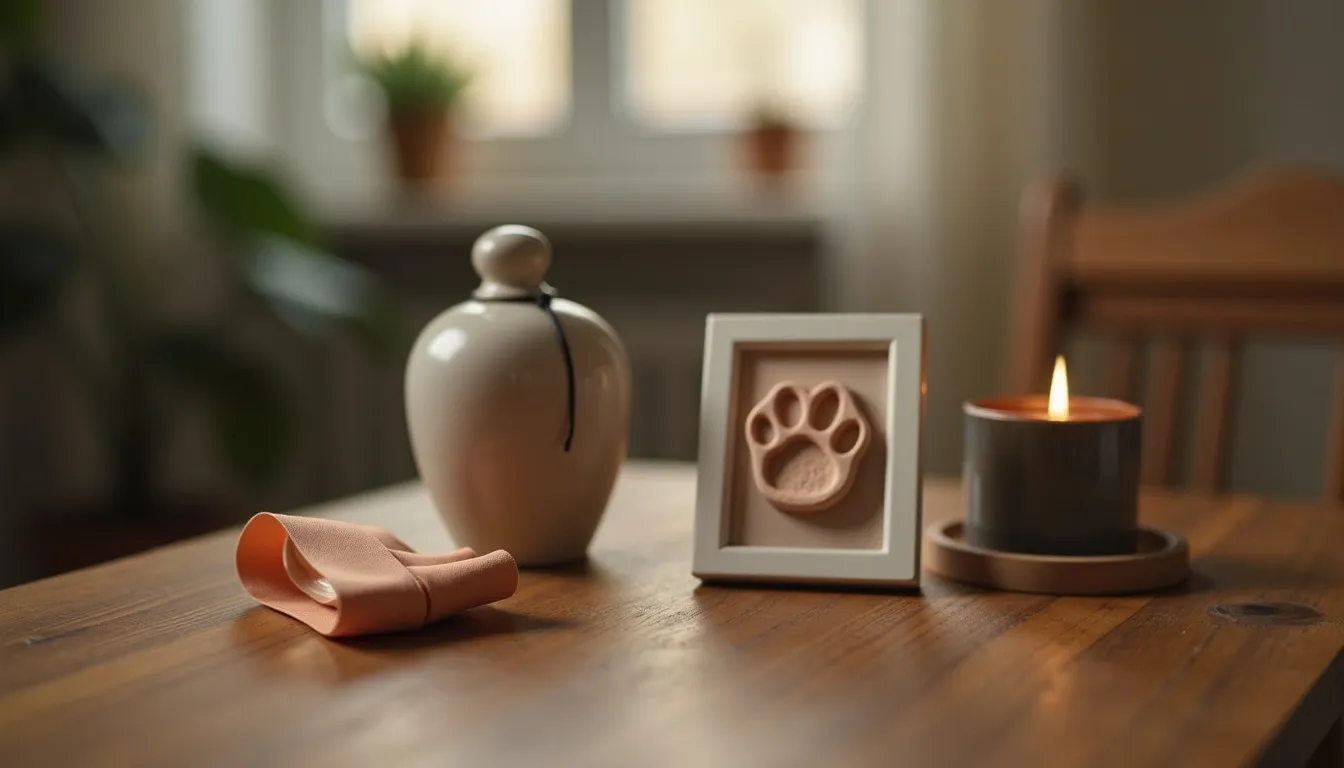
The short version: the pet memorials people find most comforting are usually the simplest — a paw print, an urn for the ashes, a framed photo, jewelry that holds a little ash or fur, a tree planted in their name, or a donation to a shelter. Several of the best (a paw print, a fur clipping, a photo) cost little or nothing. There’s no right one, and no deadline to choose.
Below are the real options, what each actually costs as of June 2026, and the few things worth knowing before you spend a cent. This is the honest version. Most “pet memorial ideas” lists are written to sell you something. Hallowed Paws is an independent resource built for pet owners, not the industry — we sell no keepsakes — so this is just what’s out there, what’s fair to pay, and where the catches are.
Start with what’s often free
Before you buy anything, know that several of the most meaningful keepsakes are usually offered at no charge — and are easy to pay for twice if you don’t realize it.
A paw print, a fur clipping, and a favorite photo are, for a lot of people, enough. Everything below is for if and when you want more — not because you’re supposed to.
Keeping the ashes: urns and keepsakes
If you chose cremation and kept the ashes, the first question is simply where they’ll live. The honest truth about urns is that price reflects material and craftsmanship, not how well they “honor” your pet — a $40 wooden box holds ashes exactly as faithfully as a $300 bronze one.
- Simple wood, ceramic, or tin urns — roughly $30–$100. The most common choice, and entirely dignified.
- Custom, engraved, or artisan urns — roughly $100–$300+, depending on material and personalization.
- Keepsake (small) urns — $20–$60 — hold a small portion, so several family members can each keep some.
- Photo or shadow-box urns — combine the ashes with a picture, collar, or tag in one display piece.
The one practical thing to get right is size. The standard is one cubic inch of urn capacity per pound of your pet’s healthy body weight — so a 60-pound dog needs about a 60-cubic-inch urn. Our pet urn size calculator does the math from your pet’s weight so you don’t order one that’s too small.
Wearing them: memorial jewelry, glass, and “ash diamonds”
Jewelry that holds a small amount of ash or fur is one of the most popular memorials — and one of the easiest to overpay for or get wrong. Here’s the honest landscape.
Fillable pendant
~$50–$150Holds a pinch of ash or fur
- You fill it yourself; ashes stay with you
- Widely available in steel, silver, gold-fill
- Lowest cost, lowest risk — nothing is sent away
Infused glass or resin
~$80–$300Ash set into the piece
- Hand-made; a small amount of ash is permanently set in glass or resin
- You mail in the ash — vet the maker first (reviews, return policy, how much they need)
- Ask whether unused ash is returned
Memorial "diamond"
$1,000sLab-grown from carbon in the ash
- A months-long lab process, not a quick keepsake
- Far more expensive; confirm exactly what is returned and the timeline in writing
- Reputable labs provide documentation — ask for it
Prices are typical 2026 ranges before customization and shipping; precious metals and larger stones cost more.
The advocacy point: any time you mail your pet’s ashes to a stranger, treat it like hiring any other service. Read recent reviews, confirm in writing how much ash they need and whether the rest comes back, and be wary of prices that seem too good — the cheapest “ash” jewelry online is sometimes filled with generic material, not your pet’s. A small, simple piece you fill yourself avoids the risk entirely.
When we read the live product pages of 30 real makers in June 2026 for our pet cremation jewelry guide, only two of five hand-blown-glass makers stated a clear return-of-unused-ash policy on the page, and none offered any proof the finished piece contains your pet’s ash rather than generic material. That guide covers every type, honest price ranges, and a checklist for vetting a maker before you mail anything — including how to do it with fur instead of ashes.
Growing something: living and garden memorials
A tree, a rosebush, or a quiet corner of the garden gives you a living place to return to. But there’s a piece of chemistry almost no listicle mentions, and it matters.
Other living and garden options, no chemistry required:
- A memorial plant or tree grown in their name (no ashes involved) — the simplest version of the idea.
- An engraved garden stone or stepping stone — roughly $25–$100, or homemade for less with a kit.
- A bird bath, feeder, or bench in a spot your pet loved to sit.
Making something: prints, portraits, and shadow boxes
- Custom portrait — a painting, drawing, or digital illustration from a favorite photo, roughly $50–$500 depending on the artist and medium. Supporting an independent artist often costs less than a “premium” mass-market service.
- Shadow box — frame the collar, tag, a paw print, and a photo together. A meaningful afternoon project, not a purchase.
- Photo book or printed album — a small, finite thing to hold, which many people find easier than scrolling a phone full of pictures.
- Nose-print or paw-print art — turned into a print, embroidery, or a small tattoo (memorial tattoos vary widely, commonly $100–$400+).
Giving in their name: donations and acts
For many people the memorial that helps most isn’t an object at all.
- Donate your pet’s unused supplies — unopened food, beds, blankets, and toys are always needed at local shelters and rescues. Giving them in your pet’s name turns the hardest part of clearing up into something that helps another animal.
- A donation to a shelter, rescue, or veterinary fund in their name — any amount.
- Sponsor or foster an animal when you’re ready. Some people find a new bond is the truest memorial; others need a long time, or never do. Both are right.
A simple way to decide
You don’t have to choose any of this now, or ever. But if you’d like a place to start, this short plan keeps it from feeling like one more thing to get right.
Common questions about pet memorials
What are some good pet memorial ideas?
The memorials people find most comforting tend to be simple: a paw print, an urn or keepsake box for the ashes, a framed photo, jewelry that holds a little ash or fur, a tree or plant grown in their memory, or a donation to a shelter in their name. There’s no “right” one — the best memorial is whichever one helps you, and there’s no deadline to choose it. Many of the most meaningful options (a paw print, a fur clipping, a photo) cost little or nothing.
How much does pet memorial jewelry cost?
Most pet memorial jewelry that holds a small amount of ash or fur runs roughly $50 to $300, depending on the metal and the maker. Simple fillable pendants sit at the low end; hand-blown glass that suspends the ash, fingerprint or paw-print pieces, and solid precious-metal settings cost more. Turning ashes into a lab-grown “memorial diamond” is a separate, far pricier process — typically well over $1,000. Always confirm how much ash is needed and whether any is returned.
Can you plant a tree with your pet’s ashes?
Not directly — and this surprises people. Cremated remains are high in sodium and very alkaline (high pH), which can harm or kill most plants if the ashes are placed straight into the soil. To grow a living memorial, use a biodegradable “tree urn” designed for the purpose: it separates the ashes from the seed or sapling and includes a medium that neutralizes the ash over time. Mixing a small amount of ash into a large volume of soil, well away from the roots, is the safer DIY route.
What can you do with a pet’s ashes?
Common choices are keeping them in an urn at home, dividing a portion among family members, scattering them somewhere your pet loved, burying them (in a biodegradable urn or under a planted tree), or turning a small amount into jewelry or glass art. You can also do more than one — many people keep most of the ashes and set aside a little for a keepsake. Our full guide on what to do with pet ashes covers the practical and legal side of scattering.
How do you memorialize a pet without spending much?
Some of the most meaningful memorials are free or nearly so. Ask your vet or cremation provider for a clay paw print and a fur clipping — both are often included at no charge, so don’t pay for them separately if they’re already offered. Beyond that: frame a favorite photo, plant an inexpensive seedling, write your pet a letter, make a small photo book, or donate your pet’s unused food and bedding to a local shelter or rescue in their name.
What should I do with my pet’s collar and belongings?
There’s no rule and no deadline. Many people keep the collar, tag, or a favorite toy as a keepsake — some frame them in a shadow box alongside a photo and paw print. Others find comfort in giving unopened food, beds, and blankets to a shelter or rescue, where they help another animal in your pet’s name. It’s also completely normal to put everything in a box and decide later, when it hurts less.
Where to go next
- Still deciding what to do with the ashes themselves? What to do with pet ashes covers keeping, scattering, and burying them — including the legal side.
- Want to be sure the ashes you have are actually your pet’s? Private vs. communal cremation explains the difference and how to confirm it.
- Need to size or choose an urn? The pet urn size calculator takes your pet’s weight and gives you the capacity to look for.
However you choose to remember them — a paw print on a shelf, a tree in the yard, or nothing physical at all — there’s no doing it wrong. The point was never the object. It’s that you loved them, and you still do.
Connect with the provider we'd trust
Free for pet owners · we sell you nothing · no paid listings, no upsells.